The Seven Crap Commandments

I’ve got to know the insides of the so-called “science-denial” community.

I’ve met and talked to mostly pleasant people with whom I am about to politely part ways. It’ll feel like opening a window on a sunny day, catching a fresh breeze, and emptying a bucket of insane, junky, corrosive Facebook content.

There’s only one way to list what I’ve learned. Having been in this game for a year, I wrote a manual – a guide on how to get Facebook likes and YouTube views… just for talking crap.

It’s the seven crap commandments. What?


Number 1: no half-measures. If you want to be a flat-earther, you’d better be willing to not just dispute the shape of the ground, but publicly deny the existence of gravity, space travel, and fundamental science. If you’re not, skeptics will more easily target the inconsistencies in your argument, even as your own team ostracises you as “controlled opposition” because your views are too suspiciously normal for their liking. Plus it’s a small stage – there will always be a more zealous preacher ready to take your social media limelight if your opinions don’t get enough blood pumping.

Number 2: trust nobody. Unlike typical cults where money and services change hands, your only currency as an anti-scientist is internet fame among your community. Grow too high and you run the risk of being cut down by those envious of your social media success. They will say you are acting as a “shill” for a perceived enemy, usually space agencies or governments. Meanwhile your old friends from normal life are all just one aggravating comment away from being un-friended as your social network narrows more and more into only science-deniers.

Number 3: never get high on your own supply. Meaning: the most successful science-deniers are the ones who don’t plunge into deeply believing what they preach, instead focussing on developing a charismatic persona and skills for making YouTube videos. True believers are more likely to become reclusive as their existential questions lead them to increasingly bizarre corners of the internet and away from the majority of the community. Your perfect level of belief should support your self-esteem and sense of belonging, but it shouldn’t be dug in so deeply that it affects how you process reality. Otherwise your mental health is at real risk.

Number 4: keep your family and business completely separated. If you think the whole world is a lie and your wife doesn’t, you’ve got a problem. You could solve this problem by not having a wife, or not telling her. Science-deniers who have not told their wives have been known to not have a wife as a result. Or you could bypass the whole thing if your family is your business, selecting a partner whom you met inside the science-denial community. This is an excellent way of raising unvaccinated children, should that be your aim. Just hope that your partner never has a change of heart about conspiracies for the rest of their life.

Number 5: the vaguer your statements, the better. Your beliefs fall down under scrutiny and, on some level, you know it. So stick to the big picture. Arguing the details of physics or aviation runs the risk of encountering a real physicist or aero engineer, but you’re safe if you say the whole world is a giant lie. Such a huge statement will elicit incredulity from the person opposite. You can interpret this as an inability to process the sheer scale of the secret knowledge to which you have access. You will use the phrase “cognitive dissonance” at this point. As a last resort, vagueness can also provide a path for dignified retreat: “everything is a conspiracy” can be wound back to “governments are keeping secrets”, a statement that people typically agree with.

Number 6: learn to fight dirty. Eventually, someone in a face-to-face conversation will ask you a question you can’t answer. Your dignified escape will depend on your ability to do one of three things: Avoid, Alter, or Appeal. So firstly that’s Avoid the question – by changing the subject and hoping the other person doesn’t notice or doesn’t want to be rude. Or you Alter the question, answering something slightly different on premises favouring you. Or lastly you could Appeal – position your argument morally with an appeal to “natural wisdom”, an appeal to our children’s wellbeing, or a reminder of what Hitler did – the list is endless. One example, appealing to common sense, is so useful that it has its own commandment.

Number 7: appeal to common sense. You’re going to be targeting educated people who embody the ideas you oppose. Your best weapon is a self-awarded sense of grassroots wisdom that you think they don’t have. It can be used in several ways. Firstly you can end many arguments by saying that the truth is obvious. For example, the moon looks small and close so, in a sense, it’s ludicrous to suggest otherwise. You can also dismiss any argument involving sophisticated reasoning or theory: too complex to understand equals too complex to be true, by virtue of common sense. Last but not least, you can attack your opponent’s character, suggesting that their excessive time spent in academic institutions has robbed them of the street-smarts that you yourself possess. When they point out that their day-to-day life is much the same as yours, remind them that’s irrelevant: they must lack common sense… because they believe the moon landings happened.
We thought the world was flat before Columbus…right?

Well, some of us still think it today.

One such person is Dave Marsh, an NHS Supply Chain manager from Ripley. I met Dave last year, among other flat-earthers whose stories I’ve been editing into a little film. I visited Dave for a longer interview because I think his opinions are representative of British flat-earthers and, compared to the average, he’s outstandingly able to express them in sentences.

In the couple of hours we spent talking, he said plenty of things that you’d have to be a big-time science denier to believe: gravity doesn’t exist; space doesn’t exist; the earth should be considered flat as of 2017. But he also said something that might not give you pause: the earth was considered flat as of 1500.

It’s supposed to be a common misconception that renaissance-era thinkers and explorers were the first to see how the earth is round. Maybe the real misconception is that people really believe that, but you can be sure of one group who does.

The Columbus myth – that is, some imagined group promulgating The Globe circa 1400-1600 – is obviously useful to flat-earthers, because it means The Globe is an upstart idea – a product of the same Modern Era that gave us American slavery, the Nazi party, and frosted tips.

Dave had been telling me about his own belief about the shape of the world, which is that it’s not only flat but completely rectangular – essentially what we call the Mercator projection today.

‘Remember,’ he segued, ‘the square map, the Mercator 1592 map – which was obviously brought out in 1592 – was out before the globe. Yeah?’

I wasn’t sure that was true, but by benefit of doubt, perhaps he meant it came out before the first ever physical model of a globe?

Dave continued. ‘Kno’mean? I know that Copernicus brought out the globe in, I think it was, 1492 or 1493, but the flat maps were around a hell of a long time before any globe model. We’ve only believed we live on a globe since, uh, the 1400s.’

I was feeling more doubtful. Remembering my prep for Dave’s interview, I recalled Eratosthenes and his measurement of Earth’s radius. He was one of the ancient Greek blokes. When exactly did he live? I couldn’t remember, and Dave was talking fast.

‘Every cosmology, whether it’s Navajo, Norse, the, uh, Mayan, all say that it’s a flat plane. With, like, a sky, whether it’s some kind of barrier or whatever. Only the Greeks believed we lived on a ball. So–

‘But nobody after that?’ I interrupted.

‘Well yeah, the Greeks have always believed it, kno’mean? But it wasn’t till Copernicus that we actually believed we lived on a ball. Then Jesuits from– Went across the entire country, uh, different places– China. Introduced the globe to China, different things like that and, like I say, these guys always believed we lived on a flat stationary plane, and they’d been introduced to the globe like every other country. So that’s what I believe.’

Gosh. Where do I begin?

Overall, Dave is describing a version of world history that simply did not take place. First things first: ancient belief in a flat earth. It’s unclear what this should disprove. Nobody’s claiming that humankind always thought the earth was round, since somebody had to be the first to suggest it. Whoever that person was, they lived in, or before, the 5th century BC, because that’s when Greek writers began adopting the idea: Plato; Aristotle; Archimedes. So of course the Romans got the idea: Cicero and Pliny both wrote about a round earth.

Given the Roman Empire, it’s safe to say that any flat-earth believers would have found themselves ridiculed anywhere in Europe by about the 8th century. Dave is also forgetting about a small place called the entire Islamic world, which spent the Medieval period perfecting tools like the astrolabe, based around, you guessed it, spherical astronomy.

So where does Dave’s narrative come from? He mentions the Chinese, who didn’t acquire a spherical model until the 17th century. What he’s not mentioning is that, by that point, not only was the model adopted by every other scientific civilisation on record, but it had been for centuries.

Aside from how it’s drawing a conclusion from an outlier, Dave’s argument is quintessentially flat-earth for one reason: Appeal to the Ancients.

It’s a technique you’ll see used everywhere from the astrologer to the homeopath – and it’s ubiquitous among conspiracy believers because it empowers belief in just about anything, as long as it’s old, mysterious, and rejected by the mainstream.

Here’s how you do it. You pick an extinct, exotic-sounding civilisation, and with the confidence of Western condescension, you state: They knew less than us about science, so they’re required to know more than us about something else. Now you’re ready to make all sorts of claims: the Pyramids were built by aliens. Cancer is cured by herbs. The world is definitely going to end in 2012.

But of course, since they weren’t, it’s not, and it didn’t, we pay no more attention to these ideas than we do to whether or not the ancient Norse thought the world was flat. I mean so what? They also believed in a guy called Jormungandr. He was a giant snake that encircled the flat earth.

That’s the problem with pre-scientific thought (or if you’re a modern flat-earther, anti-scientific thought). You’re trapped in a scary version of the world, which you can either attempt to make less scary with supernatural stories, or you can shrug your shoulders and say “Things are as they appear. I live on a green surface under a blue thing. It turns black at night, and that’s all I can know.”

Anti-science belief is is a hostile rejection of the non-obvious, and of the scientific mandate to reconcile our place in the world by means other than a terrifying giant snake. It is a refusal to hear ideas that do not come unadulterated from the same eyes and ears that furnished our caveman ancestors with a blue sky above and green earth below. Learning more might be scary, but it’s an adventure. If you’re afraid of that adventure, I wish you the best of luck. The flat-earthers are always recruiting.

Fake tools for real science

This blog post was originally published on the website of the Museum of the History of Science, University of Oxford. It has been revised and adapted.


It is easy to forget the past.

This is perhaps most true of technology. We have no reason to think about it, but every day we do something utterly radical. We reach for a smartphone, and we’ve harnessed the power to combine communication with unbounded access to knowledge.

Our devices do lots besides connecting us. On mine I have one of several free apps that lets me point it at the sky and find the names and positions of whatever stars and planets I’m facing. If you install something similar, in seconds you’ll have in your pocket a tool far better than anything owned by your stargazing predecessors.

With such information so easily to hand, one could be forgiven for forgetting about the age before computers: the age of the astrolabe.

“What’s an astrolabe?” I wondered. I’d been invited to join a team of volunteers at the Museum of the History of Science, to improve their display of astronomical instruments from the Islamic world. Firstly I learnt that an astrolabe is a handheld device – intricate, delicate, and particularly beautiful – for the observation and prediction of celestial motions, and the measurement of time and latitude. Secondly I learnt that they were generally associated with the Islamic world from the medieval period onwards.

An astrolabe has hundreds of functions, and it’s portable. Comparisons with our modern smartphones are forthcoming. In fact, there’s already a superb article about the parallels between these two handheld devices [1].

But one need only look at any of the astrolabes at the Museum to know that their value extends far beyond their function. The finery and creativity of their decoration says more than words could about the astrolabes’ other purpose: status symbols.

tom_holds
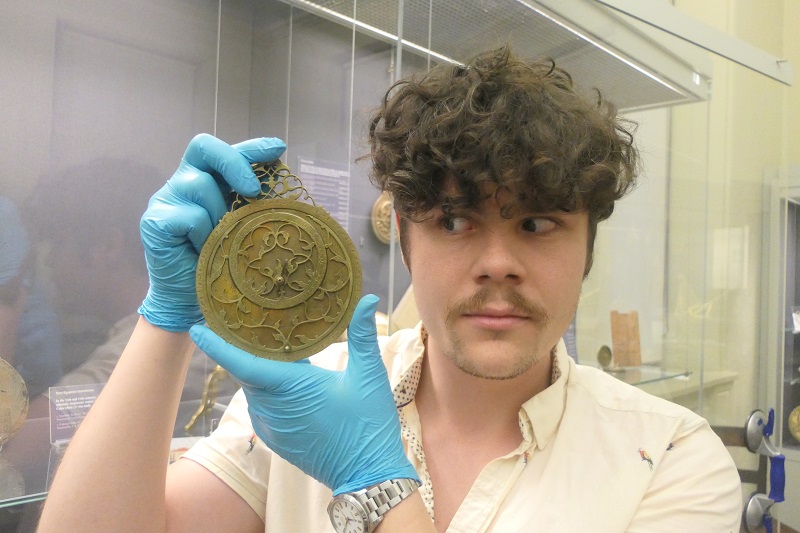
The author holds a genuine Abd al A’imma astrolabe from the collection of the Museum of the History of Science

A modern analogy could be an expensive wristwatch. It seems the basic idea is the same today as it was in eighteenth-century Isfahan, even though they didn’t actually have wristwatches.

Everyone needs to tell the time, but if you have the means, you may be tempted to tell it with something flashy. In Persia (and in Europe amid the Scientific Revolution) people also needed to predict sunsets and sunrises, chart the stars, and measure latitude. An astrolabe could do it all and more.

Despite newer and better instruments, its versatility and portability maintained it as the must-have motif for an era when science was in vogue.

rete
The rete of the astrolabe, the moving part that sits in front of the plates

Naturally some astrolabes were nicer than others. The ultimate state of the art was around 1720, just before the fall of the Persian Safavid dynasty, and it involved a craftsman named Abd al A’imma. His skill as one of history’s finest astrolabe-makers is evident in his work held at the Museum. Other museums have pieces bearing his name, and some of them are wonderful for quite a different reason: they’re fake.

Their existence confirms al A’imma’s prowess not just as a craftsman, but as a brand name. They reveal themselves in much the same way as would a fake Rolex or a knockoff Gucci bag. The details are off; the fit and finish aren’t up to standard – there are even misspelled engravings, an artefact of the Persian forgers’ poor grasp of Arabic [2].

umm
The umm of the astrolabe

Perhaps we should take a cynical view of all this. Materialism and fakery are as old as can be. Amazing technologies are doomed to start out as an art practised by experts, then become an exclusive pursuit, then end up as a commodity. Even precise timekeeping, once the domain of astronomers, has long become a forgettable feature of our ubiquitous smartphones.

We can think better. Why might something be imitated? The obvious answer is that it has a value deeper than the sum of its materials. And when that value is associated with something so scientific, so insightful, so ingenious as an astrolabe, surely we owe our respect to the culture that made it worth faking. The Abd al A’imma forgeries, by existing, demonstrate a reverence for science, and a desire to practise it.

Does the same desire exist today? Our answers depend on individual belief, yet many of our most pressing global issues depend desperately on a collective belief that scientists and experts must be listened to, and trusted. Maybe this culture existed more in 1720 than it did today, which would mean the advancement of time does not guarantee the advancement of thinking.

So when we take a moment to consider the phoney astrolabe, the fake Rolex, or the 5G Samsung, we remember the history of science that connects them – science which, just like them, exists for a reason.

plate
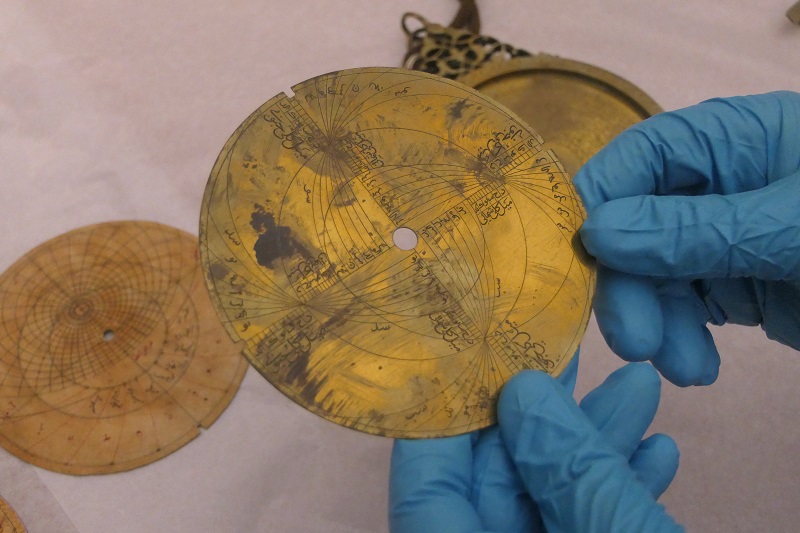
One of a set of swappable plates that come with the astrolabe, for use at different latitudes


[1] Jane Louise Kandur, Astrolabe: the 13th Century iPhone, Daily Sabah, 2015.

[2] Gingerich, King, and Saliba, The Abd al A’imma Astrolabe Forgeries, Journal for the History of Astronomy, vol 3, pp. 188-198, 1972.